
What is Spray Polyurethane Foam (SPF)?
Spray polyurethane foam is an alternative to traditional insulation types such as fiberglass and cellulose. SPF is a highly-effective insulation and sealant material which is spray-applied, and it can be used on walls, ceilings, attics, basements, crawl spaces, and even roofs. SPF is a two component system containing isocyanates (A-side) and a polyol blend (B-side). During application, the A and B sides are fed through hoses to a spray gun where they are mixed and sprayed under pressure. Once the mixture hits the substrate surface, the material rapidly reacts and expands.
Does SPF Application Present any Health Risks?
Yes, exposure to SPF chemicals poses health risks such as irritation and chronic lung disease to applicators or other workers in the area. Proper personal protective equipment (PPE) is highly recommended to protect the applicator from skin, eye, and inhalation exposure. In addition, isocyanates (A-side) are strong sensitizers that may cause an allergy-like response in some people and are the leading chemical cause of work-related asthma. A person may become sensitized after long term or even the initial exposure. A sensitized person can suffer a severe or fatal asthma attack even when exposed to very low levels of these chemicals. The B-side component may also cause adverse health effects as they contain blowing agents, amines, flame retardants, and other chemicals.
It is important to note that SPF only poses health risks during application. When properly applied, this material is safe and does not require PPE to be worn when around fully cured.
Why is Ventilation Important?
Properly designed ventilation can reduce airborne levels of aerosols, mists, and vapors generated during spray application and can help protect not only the applicator(s), but anyone else that may be working in adjacent areas.
During and after spray application, vapors, mists, particulates, and dust from trimming or sanding the foam may linger until the area is ventilated and cleaned.
When possible, it is best to schedule SPF installation during a time when no other trades or occupants are in the vicinity of the application.
Fundamentals of Ventilation
Ventilation measures are taken in order to control worker exposure to hazardous airborne chemicals or flammable vapors by exhausting contaminated air away from the work area and replacing it with clean air. There are two basic types of ventilation–general exhaust ventilation and local exhaust ventilation.
General exhaust ventilation systems, also known as “dilution ventilation,” dilutes contaminated air by mixing it with clean air. These systems typically consist of an exhaust fan which pulls air out of the room and discharges it outside. Replacement air is brought into the area by either natural means, such as windows, doors, and exterior vents or can include a separate make-up air fan, duct work, and air registers that provide clean air to the room.
This system is not recommended as the sole source of ventilation when hazardous vapors or mists are present, because they do not immediately remove contaminants from the workspace.
Local exhaust ventilation systems remove chemicals and other contaminants at their source. In these systems, the exhaust hood or vent is placed as close as possible to where the work is performed to capture and remove contaminants before they mix with the rest of the air in the room. Local exhaust ventilation systems are recommended for controlling hazardous vapors, mists, dusts, and particulates because if designed properly, they remove the contaminants before workers are exposed.
A local exhaust system is most appropriate for an SPF application. Vapors, mists, dusts, and particulates are emitted during the spraying and trimming processes. General ventilation would be appropriate after the application of SPF. This would allow the workspace to be ventilated before other workers or occupants enter the area.
SPF Ventilation Challenges
A ventilation system is normally designed to serve a specific location or room where the operation is well defined. For example, a spray booth used for spraying truck bed liners will always have the same room dimensions and the application process will always be the same. As a result, an effective ventilation system can be designed and installed to the exact specifications of the room.
The application of SPF to walls, ceilings, attics, and basements within multiple job sites, however, presents ventilation challenges because every job site will have different room sizes and shapes. Additionally, the process requires frequent movement of workers as the work progresses resulting in harmful vapors, mists, dust, and particulates being generated throughout the workspace.This work area variability prevents a “one size fits all” approach and presents challenges associated with designing a “booth-like” enclosure/ventilation system.
Because of this variability, it is important for SPF insulation applicators to understand some basic ventilation principles so they can implement effective ventilation controls in the wide variety of work configurations that they face. A properly designed ventilation system can help protect workers and building occupants, whereas an improperly designed system could make matters worse.
Basic Ventilation Design Principles
Because the source of emissions moves as the work progresses in SPF applications, designing a local exhaust system can be difficult. In fact, in many cases the system may look more like a general exhaust system. There are some tips to consider, however, to maximize the system’s effectiveness. The key to understanding and applying these tips is understanding the three important components of a ventilation system and how they work together. These components include:
- The work space, room, or enclosure to be exhausted.
- The exhaust system–including a hood or exhaust vent, ductwork, and fan–that captures contaminants at the source and transports them to a location outside the building away from HVAC air intakes and occupied areas.
- The make-up air which is the fresh air to the room or work area that replaces the exhausted air. This can either be forced make-up air (air forced into the room with a fan) or passive make-up air (air drawn into the room through openings such as doors, windows, or exterior vents).
How you design or place each of these components will determine the effectiveness of your system.
Establish Air Flow Across the Spraying Area
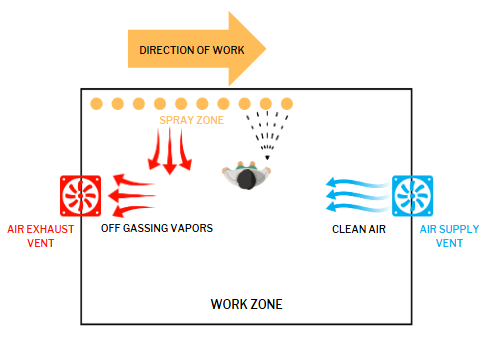
A fundamental consideration of any ventilation system is that the system creates an air flow from the make-up air entry location to the exhaust collection point (e.g., hood or vent). It is important that this flow of air:
- Flows across the entire workspace to be ventilated. This is achieved by ensuring the make-up air entry location is on the opposite end of the work area from the exhaust hood or vent.
- Draws contaminants away from the workers. When possible, applicators should begin spraying near the exhaust hood or vent and progress away from that point so that off-gassing from applied SPF is drawn away from the applicator. Helpers should also work upstream from the sprayer.
Related tips:
- Avoid improper placement and direction of fans. Simply pointing fans at the work area without establishing a directed air flow pattern will only stir up the air creating a greater potential for workers to breathe the contaminants. This could also lead to the unintended escape of contaminants to other work areas.
- Remember to place the exhaust hood or vent as close to the point of application as possible. As an applicator moves around a working area, reposition the fans so they remain close to the application process, if possible. Placing the exhaust fan close to the source of emissions minimizes the potential for the contaminants to mix with the rest of the air in the room.
Establish Enclosures to Isolate and Contain the Work Area
Establishing enclosures around the work area serves two important purposes:
- Prevents migration of contaminants to other areas of the building. This protects workers in other areas and minimizes the need for more widespread building ventilation during the application process and prior to occupancy.
- Improves the efficiency and effectiveness of the ventilation system by minimizing the size of the area to be ventilated (which affects the number and size of fans needed) and by helping to direct or channel the airflow to the exhaust vent or hood.
In some cases the configuration and size of the room where the application will occur may be sufficient to isolate the work area. In other cases, it may be necessary to construct temporary enclosures. Such enclosures typically include plastic sheeting with overlapped seams sealed with tape.
Remember to place warning signs on entrances to the enclosure or work area to alert other workers of the hazard and prevent them from entering the area.
Related tips:
- Maintain a negative pressure in the work area or enclosure. This is accomplished by ensuring that you exhaust more air from the room than you supply. A negative pressure in the enclosure will prevent contaminated air from escaping the enclosure by ensuring that if there are any leaks, the leaks will be into, rather than out, of the enclosure. If you use forced supplied air, you can maintain a negative pressure by ensuring that your exhaust fan capacity (CFM) is greater than your make up air fan. If you use passive supplied air, your exhaust fan alone should be sufficient to create a negative pressure. A smoke tube can be used as a basic tool to evaluate whether the enclosure is under negative pressure.
- Avoid openings that will short circuit your ventilation system. Remember that because you have a negative pressure in your room or enclosure, air will be drawn into the room from any opening (intentional or unintentional). Poorly placed openings can short circuit your intended flow of air and create dead spaces. This is particularly important with passive make up air systems.
- Remember to shut down and seal off HVAC openings in the work area to prevent migration of contaminants to other areas of the building, as noted earlier. Don’t forget to unseal and restart the HVAC system prior to re-occupancy after the SPF has fully cured and the work area has been ventilated and cleaned.
Direct Exhaust to a Safe Location
Always remember to direct exhaust to a safe location outside the building, away from areas where other workers or people are or could be present. If the exhaust is at ground level or at other areas where people could enter, you should also establish a control zone using warning signs and physical barriers around the exhaust area to prevent personnel access. You should also be aware of where air intakes are for neighboring buildings and direct your exhaust away from these areas.
Related tips:
- Particulate exhaust filters should be used to remove SPF dusts and mists from the exhaust air. This not only helps to minimize hazardous air contaminants in the exhaust air but can also prevent SPF from settling on nearby vehicles or other property. Note that SPF can also buildup on the exhaust fan blades significantly reducing the exhaust fan’s efficiency over time. For this reason, the exhaust filter should be installed in front of the fan to remove the dust and mists before they reach the fan. Clogged filters can also reduce efficiency, so remember to follow the filter manufacturer’s recommendations for filter replacement.
- Some SPF vapors and mists can present explosion hazards at certain concentrations. As a result, you may need to use a fan rated for use in explosive environments. Check with the SPF manufacturer to determine if certain uses of the product pose this hazard.
Ensure Adequate Ventilation Following Application
Always remember to continue ventilating the area following application until the material has fully cured, off-gassing has stopped, and vapors have been removed. During this time, worker re-entry should be kept to a minimum and should only include those with appropriate respiratory protection (and skin protection if contact with SPF is possible). Occupant re-entry should only occur after the building is fully ventilated. The amount of time needed for this depends on several factors including:
- SPF Formulations and Related Cure Times
- Accurate Proportioning and Mixing of A-Side and B-Side
- Ventilation Rate
- Temperature and Humidity
Check with the manufacturer of your SPF product to determine an appropriate re-occupancy time and ventilation rate.
Conclusion
After Reading this post, we hope you have a much better understanding of why creating a ventilation system is important during the SPF application process.
How do you create your own ventilation systems? What do you do differently? We’d love to hear from you! Leave a comment below discussing your experience, thoughts, tips, or questions you have about ventilation systems.